




Gossip isn’t limited to social circles; the workplace is just as vulnerable. From stories about Christmas party antics to whispered conversations about colleagues by the water cooler, offices are full of gossip waiting to be shared.
To understand how widespread workplace gossip really is, we surveyed 1,000 people about their habits and how often these chats pull them away from their tasks. We also analysed average hourly wages across 20 UK industries to estimate how much these distractions may be costing businesses nationwide, and other ways employees are wasting their time on the clock.
Key findings:
- The technology and IT industry are costing employers the MOST by gossiping away £49,955 per person every year.
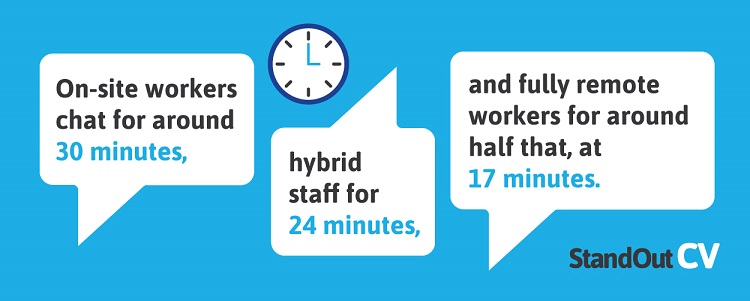
- People who work on site every day spend around 30 minutes a day gossiping whereas those who are fully remote spend almost half as much time (17 minutes).
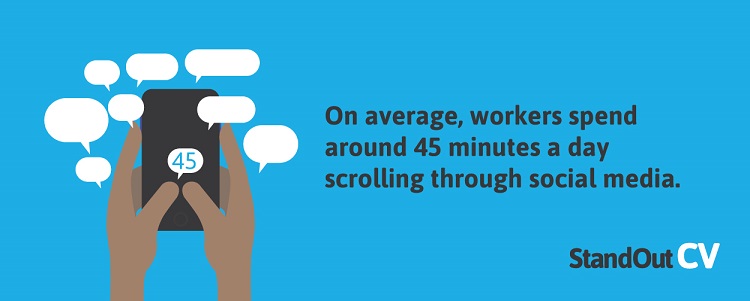
- On average, respondents admitted to spending around 45 minutes per day scrolling through social media, alongside playing games (37 minutes) and checking personal messages (29 minutes).
- Most people turn to WhatsApp to gossip or talk about non-work related conversations (67.4%).
- Over one in six (17.1%) say they worry about the impact of gossiping on their productivity levels, but it makes their work more fun.
- For almost half (49.8%), following the work Christmas party gossiping increases slightly, with drunken behaviour the most common topic (19.4%).
How much time is spent gossiping at work?
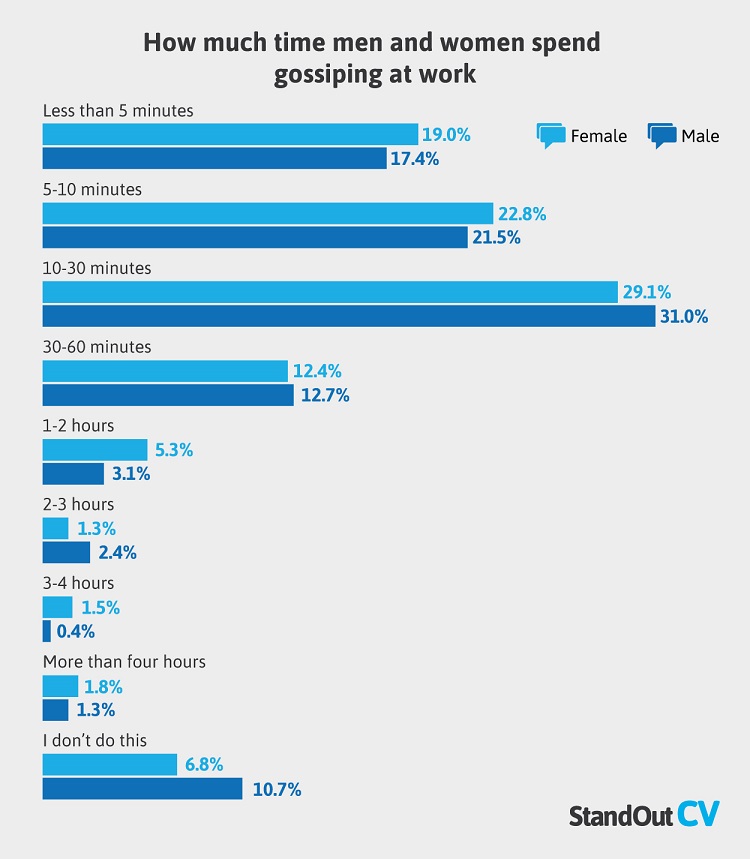
On average, the employees we spoke to say they spend around 30 minutes a day gossiping at work. Over a five day working week, this adds up to two and a half hours, 10 hours over a month or 130 hours over an entire year.

When looking at the findings by seniority, those in senior leadership roles such as CEOs, directors and executive team members were the least likely to gossip, with 14.9% saying they never take part in these conversations. In contrast, employees in middle management were the least likely to say they never engage in gossip (5.5%).
Although 10.1% of men insisted they never gossip (compared with 6.8% of women), their own estimates tell a different story: men still confessed to about 25 minutes of gossip a day, only slightly behind women at 28 minutes.
The financial impact of gossiping at work
As part of the study, we examined how time spent gossiping could affect a company’s finances. To do this, we first calculated the average amount of time employees in each of the 20 industries reported spending on gossip each day. We then compared these figures with the average hourly salaries for those industries across the UK. By multiplying the average time spent gossiping by the average hourly wage, we were able to estimate the cost of workplace gossip per employee, per day, and per year, providing a clearer picture of how informal conversations can translate into financial losses for businesses.
The tech and IT industry have the highest daily cost per gossip (£197 per day)
The research found that employees in tech or IT are costing their employers the most, with an average of £197 per person wasted each day on gossiping.
Those working in finance and insurance follow at around £150 a day, while staff in health or social care account for £144. Over the course of a full working year, this could rise to more than £49,955 in the technology sector, £37,892 in finance and insurance, and £36,491 in health or social care.

The yearly cost of workplace gossiping per employee
| Industry | Price of gossiping per year |
|---|---|
| Technology or IT services | £49,955 |
| Finance or insurance | £37,892 |
| Healthcare or social care | £36,491 |
| Retail | £20,309 |
| Education or training | £19,065 |
| Manufacturing or construction | £18,686 |
| Public sector or government | £6,704 |
| Hospitality | £4,571 |
| Property | £3,944 |
| Legal services | £3,365 |
| Agriculture or environmental services | £1,364 |
| Charity or not-for-profit sector | £3,279 |
| Transport or logistics | £3,123 |
| Marketing | £3,044 |
| Energy or utilities | £2,708 |
| Automotive | £2,633 |
| Creative or media industries | £946 |
| Leisure, sports or tourism | £843 |
| Beauty | £569 |
| Grand Total | £219,501 |
Remote workers gossip almost half as much as those in the office full time
Among those currently employed, just over half (51.2%) work on site full time, while 10.7% work entirely from home and 38.1% follow a hybrid approach, splitting their time between home and the workplace.
Interestingly, the time spent gossiping seems to follow a similar pattern. People required on site every day spend around 30 minutes a day chatting, those on a hybrid schedule spend about 24 minutes, and fully remote workers almost half as much at 17 minutes.
So maybe companies should think twice before insisting everyone comes in all the time. More time on site can mean more time spent chatting rather than working, and with 62% of UK CEOs expecting their companies to make a full return to the office by 2027, it’s worth considering whether forcing a return is really the most productive move.
The hidden ways employees waste time during work
As part of the research, we also asked employees how much time they spend on other non work related activities.
Social media is one of the biggest time drains at work, averaging 46 minutes daily
Alongside gossiping, it seems there are plenty of other ways workers avoid their tasks. On average, respondents said they spend 46 minutes a day scrolling through social media, almost an hour with friends and family, and just over 50 minutes watching TV.
But while many admit to wasting time during the workday, our previous research suggests they may be making up for it elsewhere, with the average employee putting in around 4.7 hours of unpaid work each week.
How much time is wasted per day?
| Activity | Average minutes per day wasted on non-work tasks |
|---|---|
| Spending time with friends and family | 54 |
| Watching TV | 51 |
| Scrolling through social media | 46 |
| Playing games | 37 |
| Getting snacks or meals | 31 |
| Chatting about non-work topics (i.e. TV shows, weekend plans) | 29 |
| Checking personal messages | 29 |
| Shopping | 29 |
| Gossiping (about any matters) | 29 |
| Daydreaming or idling | 26 |
| Engaging in romantic activities | 25 |
| Running personal errands | 25 |
| Procrastinating | 25 |
| Reading the news | 24 |
| Making drinks | 23 |
| Making personal phone calls | 21 |
While this totals more than eight hours a day (compared with the average UK working day of 7.28 hours), it is likely that some of these activities overlap, such as chatting while making drinks or checking personal messages while watching TV.
Workers turn to WhatsApp for non-work related conversations
We also asked respondents which platforms they use for non work related conversations, whether they are sharing gossip or chatting about weekend plans.
The most common platform was WhatsApp with 67.4% of respondents choosing it. WhatsApp was used most frequently by those working in technology and IT at 14.9%, as well as by employees in middle management roles at 29.9%.
Despite its popularity for non-work related conversations, experts warn that you should proceed with caution when using WhatsApp for work related purposes. Issues such as encouraging communication outside of agreed working hours and data breaches should be carefully considered before adopting the platform. [1]
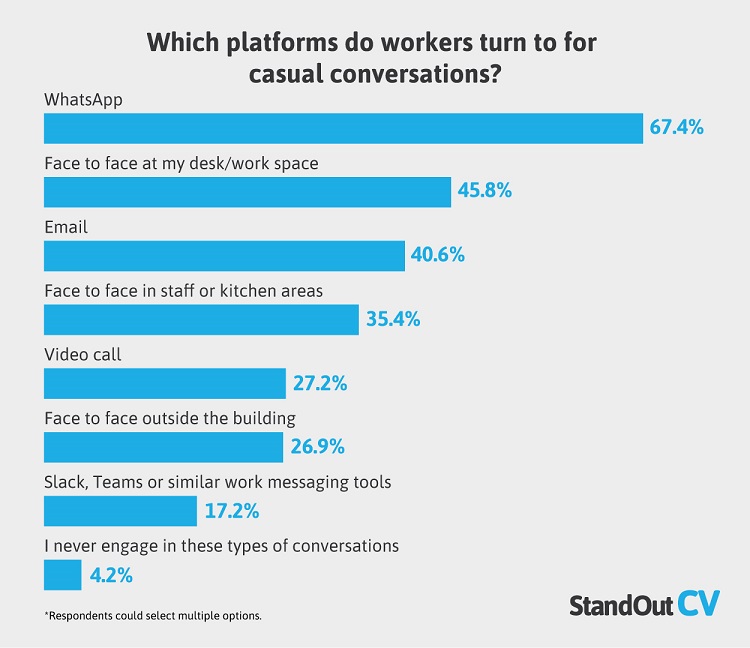
Following this, 45.8% said they prefer to hold casual conversations at work face to face at their desk or workspace, potentially to prevent the risk of any discussions being leaked or shared externally. In addition to this, 40.6% said they turn to emails to host these conversations.
A third (33.8%) say they believe gossiping over Slack feels unprofessional
The survey asked respondents whether anything makes them feel uncomfortable about gossiping or chatting informally over Slack or other instant messaging tools used at work.
A third (33.8%) said they find this unprofessional or inappropriate, while almost one in ten at 9.3% said they do not feel uncomfortable with it at all.
Despite this, in 2023 a video went viral on TikTok after revealing that your employers can read everything you say via the instant messaging platform. The video claims that senior members of a company can also request access to even your private Slack conversations, and urge people to be careful about what they share in these discussions. [2] This concern isn’t unfounded, as it’s estimated that around 1.76 million businesses are monitoring UK staff.
What makes people feel uncomfortable about gossiping over Slack?
| Concerns | Respondents (%)* |
|---|---|
| It feels unprofessional or inappropriate | 33.8% |
| Prefer to keep work and personal chats separate | 30.2% |
| Worry that messages could be monitored or shared | 26.7% |
| Don’t trust that messages will stay private | 22.9% |
| Prefer having these conversations in person | 18.7% |
| Don’t enjoy gossiping in general | 16.5% |
| Don’t want to leave a written record of casual or sensitive comments | 13.9% |
| Don’t engage in these types of conversations via messaging tools | 13.3% |
| Don’t feel uncomfortable about it | 9.3% |
*Respondents could select multiple options.
The impact of gossiping
The survey also explored whether respondents had ever experienced or witnessed negative consequences of workplace gossip. More than a quarter at 27.6% said they had seen it happen to others, while 15.2% said they had been personally affected. In more serious circumstances, HR experts warn that harmful or false gossip could be considered a form of bullying and may result in misconduct action. [3]
On the other hand, 42.1% said they’d never witnessed or experienced negative consequences from workplace gossip, which suggests that while gossip can have serious consequences in some cases, it may be difficult for businesses to pinpoint or address. [4]
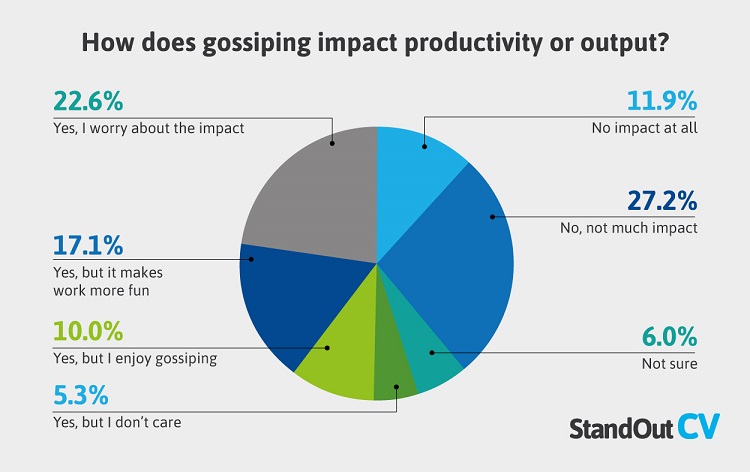
When asked whether they felt gossiping had an impact on their company’s overall productivity or output, over a quarter (27.2%) said they did not believe it made much difference. In contrast, more than one in five (22.6%) said they were concerned about the effect it could have.
Controversially, 5.3% said they did think workplace gossiping affected their productivity, but they simply don’t care about the impact. Likewise, one in ten (10%) said they also believed it affected their company’s output, but they like gossiping too much to give it up.
Why gossip peaks around Christmas
Many businesses hold end of year parties as a key moment for team bonding, but how does the event affect gossiping levels afterwards?
For almost half of respondents (49.8%), gossiping increases slightly after the party, while one in five (20.1%) said it increases significantly. Just 2.2% said gossiping actually decreases, and 27.9% reported no change at all.
In terms of topics, 19.4% said discussions often focus on who got too drunk or behaved inappropriately, while 15.7% said colleagues chat more about romantic encounters or flirtations.
Topics of discussion following the work Christmas party
| Topics | Percentage* |
|---|---|
| Who got too drunk or behaved inappropriately | 19.4% |
| Romantic encounters or flirtations | 15.7% |
| What managers or senior staff did or said | 13.0% |
| Awkward or embarrassing moments | 14.2% |
| Who didn’t attend and why | 11.9% |
| Outfit choices or appearances | 10.6% |
| Work politics revealed during the event | 7.3% |
*Respondents could select multiple answers
Fewer respondents said they discuss work politics, at 7.3%, or outfit choices, at 10.6%.
Methodology
A survey on behalf of StandOut CV was conducted in November 2025 and asked 1,021 people about their attitudes towards gossiping, and spending time on other non-work related tasks while at work. These questions covered topics such as time spent gossiping, whether they’d experienced or witnessed negative impacts of gossiping and how they most often conduct these conversations. For some questions, respondents were able to select multiple answers, so the results do not all add up to 100%.
The demographics of the survey respondents were:
Age:
- Boomers – 5.8%
- Gen X – 38.8%
- Gen Z – 14.6%
- Millennials – 40.8%
Gender:
- Female – 49.9%
- Male – 50.1%
Average hourly rate data:
- Healthcare or social care – £31.00
- Finance or insurance – £30.52
- Energy or utilities – £26.89
- Technology or IT services – £22.71
- Education or training – £22.39
- Creative or media industries – £19.24
- Manufacturing or construction – £18.97
- Legal services – £18.78
- Charity or not-for-profit sector – £18.42
- Transport or logistics – £17.90
- Other – £17.71
- Retail – £16.04
- Marketing – £15.29
- Agriculture or environmental services – £14.75
- Automotive – £14.60
- Beauty – £13.50
- Hospitality – £12.39
- Leisure, sports or tourism – £10.00
- Property – £15.96
- Public sector or government – £19.67
The industries included in the study were selected by drawing on commonly cited sectors in the UK to ensure a representative sample.
Sources
[1] Thorntons, ‘Why businesses need to consider what’s up with using WhatsApp in the workplace’, 2024
[2] Indy 100, ‘Worker urges people to stop gossiping on Slack after claiming boss can see everything’, 2023
[3] 121 HR Solutions LTD, ‘What counts as workplace gossip and why is it damaging?’
[4] DavidsonMorris, ‘Manager’s Guide to Workplace Gossip’, 2025