




Speaking another language is generally seen as a big advantage for your CV, but how much does it actually translate into higher pay and better opportunities?
To answer that, we analysed over 2,200 UK job listings to compare measurable salary and demand data across languages, regions and industries, revealing which multilingual skills deliver the strongest earning potential and where they create the most opportunities.
Key findings
- French is the highest-paid foreign language in the UK, with an average salary of £41,456, making it one of only two languages to consistently exceed the national salary baseline.
- The average salary for foreign languages (£31,909) is 18% lower than the UK average salary (£39,039).
- French and German-speaking roles are the only foreign-language jobs to beat the UK salary baseline, with French averaging £41,456 (6% higher) and German averaging £39,385 (1% higher).
- Spanish creates the most job opportunities, accounting for 30.2% of all foreign-language roles, but ranks only third for salary, highlighting a clear gap between demand and pay.
- East Sussex is the highest-paying region overall, with French-speaking roles averaging £87,402, the single highest regional salary for a foreign-language role.
- Technology delivers the highest salaries overall, with French-speaking IT roles averaging £101,807, more than double those of German-speaking IT roles (£47,417).
Which languages earn the highest salaries in the UK?
Speaking another language is an impressive feat, but how much of an impact can it have on potential salary? Each salary varies depending on the language you can speak, with some lucrative opportunities available for language-skilled jobs.
The average advertised salary for foreign-language roles is £31,909, based on analysis of UK job listings. This is below the UK average salary of £39,039, with a gap of £7,185 (18%). [1]
However, our analysis shows that there are a couple of languages that consistently earn more than the average salary.
Top 10 foreign language roles by highest salary
| Rank | Foreign-language role | Average salary |
|---|---|---|
| 1 | French | £41,456 |
| 2 | German | £39,385 |
| 3 | Spanish | £35,326 |
| 4 | Italian | £32,822 |
| 5 | Korean | £32,809 |
| 6 | Japanese | £32,400 |
| 7 | Hindi | £32,390 |
| 8 | Mandarin | £32,011 |
| 9 | Polish | £31,880 |
| 10 | Arabic | £29,198 |
| 11 | Dutch | £28,235 |
| 12 | Portuguese | £27,492 |
| 13 | Vietnamese | £25,700 |
| 14 | Greek | £25,622 |
French is the most lucrative language in the UK
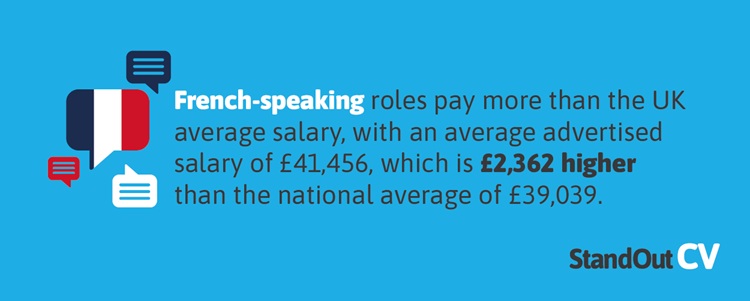
Maybe we shouldn’t ‘watch our French’ afterall, with French-speaking roles commanding the highest salaries of any language-speaking jobs in the UK, offering an average salary of £41,456. This is £2,362 (6%) above the UK’s average job salary, making French one of only two languages in the dataset to consistently exceed the national benchmark.
Unlike more specialist languages, this salary premium is sustained across a broad range of roles, making French a strong option for professionals.
German comes closest to matching the national average salary
German-speaking roles also exceed the average national salary, averaging £39,385, more than £300 above the average in the UK (£39,039). Speaking German could offer opportunities to land huge earnings with jobs in plenty of industries, including marketing, retail and IT.
Most language roles fall well below the UK average salary
Despite a small number of high-earning outliers, the majority of language-based roles sit below the national pay benchmark. Of the 14 foreign languages analysed, 11 advertise average salaries under the UK average. Even Spanish, which ranks third overall for pay and is one of only three languages with 1,000-plus advertised roles on Indeed, offers an average salary of £35,326, placing it around £3,700 below the UK average. This highlights how widespread demand does not necessarily mean higher earnings.
At the lower end of the ranking, Greek-speaking roles return the lowest average salary at £25,622, followed closely by Vietnamese (£25,700). While these figures are below national averages, they still reflect competitive pay within entry-level and specialist language-focused roles.
Which languages create the most job opportunities in the UK?
While salary highlights where the language skills pay best, job volume shows where opportunities actually exist. Despite the French and German languages offering lucrative roles, they don’t necessarily have the most opportunities, both being beaten by roles requiring Spanish.
After Spanish, there’s a huge drop-off in demand, with the fourth most opportunistic language being Mandarin, with only a 5.2% job demand, followed by Italian (2.5%).
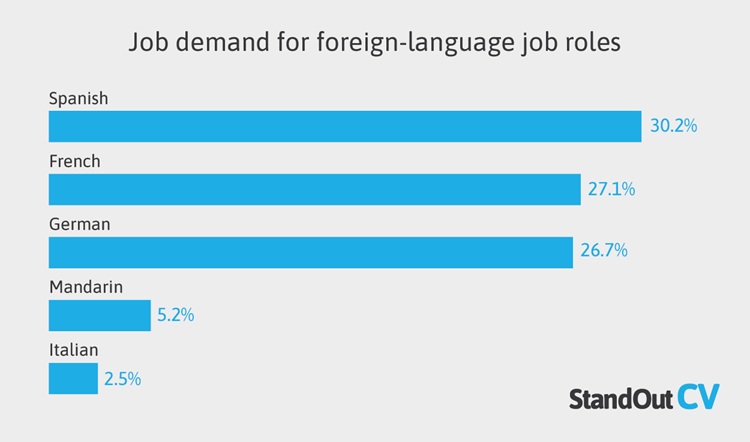
* Data note: Percentages reflect each language’s share of foreign-language roles analysed, not total UK jobs, so figures do not add up to 100%.
Spanish-speaking jobs are the most in-demand, accounting for nearly a third of roles
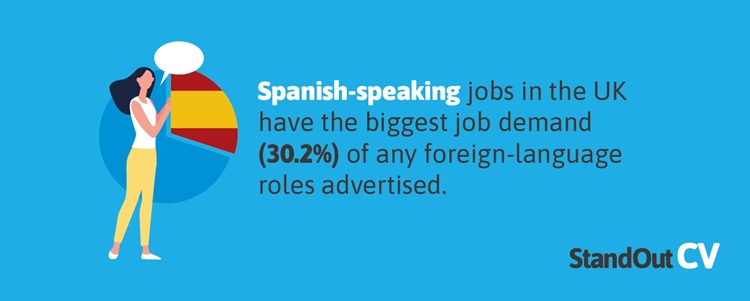
Spanish-speaking roles show the highest job demand of any foreign language, accounting for 30.2% of foreign-language jobs advertised in the UK. They appear more frequently than both French and German, highlighting how widely Spanish skills are required across employers.
This demand reflects the volume of opportunities available for Spanish speakers, although it does not necessarily result in higher salaries.
French and German follow for job demand
French-speaking roles account for 27.1% of foreign-language job listings, with German close behind at 26.7%, making them the next most in-demand languages after Spanish. Together, the three languages dominate the job industry in the UK.
Much of this demand could be down to the strong business relationships between the UK and European countries. Europe remains the UK’s largest trading partner, buying more than £350 billion worth of UK goods and services each year, with Spain, France and Germany among the most important markets for businesses, explaining why these languages dominate the employer demand across industries. [2]
Less demand for other languages in the job market
Outside the most commonly requested languages, employer demand falls away quickly. The majority of foreign languages analysed each account for less than 5% of foreign-language job listings, highlighting how concentrated hiring is among a small group of skills.
At the lower end of the market, languages such as Greek and Vietnamese represent just 0.2% of roles each, while Portuguese (0.9%), Japanese (0.8%), and Hindi (0.5%) also appear infrequently. Other languages, including Italian (2.5%) and Polish (1.6%), remain well behind the leading group.
Demand vs salary
While the relationship between job demand and salary isn’t always straightforward, the lowest-paid languages in this dataset all share one clear trait – very limited employer demand. Each of the five lowest-paid foreign-language roles accounts for less than 2% of job listings, suggesting fewer opportunities and less competition between employers.
This aligns with basic labour market principles, where skills that are requested less frequently tend to attract lower wages. Although we saw a mixture of results, every language at the bottom of the pay scale in our analysis is also among some of the least in demand, reinforcing the link between limited demand and lower average salaries. [3]
| Foreign-language role | Job demand | Average salary |
|---|---|---|
| Arabic | 1.6% | £29,198 |
| Dutch | 1.6% | £28,235 |
| Portuguese | 0.9% | £27,492 |
| Vietnamese | 0.2% | £25,700 |
| Greek | 0.2% | £25,622 |
How salaries for foreign-language jobs vary across the UK
Salaries for foreign-language roles vary significantly from one region to the next, with no single region consistently offering the highest pay across all languages.
Instead, the data reveals wide regional differences, including some outlier areas where advertised salaries are well above typical levels. The most notable opportunity is an area offering average salaries over £80,000.
French-speaking roles pay the most in East Sussex (£87,402)
East Sussex is the highest-paying region in the UK for French-speaking roles, with an average advertised salary of £87,402. An impressive £43,307 above the UK baseline, meaning French-skilled roles in this area pay around 124% more than the national average. No other region or language combination in the dataset records a higher average salary, making this the strongest location for multilingual employees.
Across the rest of the UK, French salaries show a huge disparity by region. Worcestershire (£65,000) and London (£51,659) offer the next highest averages, followed by Somerset (£51,260) and Suffolk (£38,168), the majority above the national baseline. At the lower end, Bristol (£14,003) records the lowest regional average for a French-speaking salary, followed by Hertfordshire (£22,000) and Lincolnshire (£23,500). Taken together, this shows that location alone can create a difference of more than £73,000 in average pay for the same language skill.
Top-paying regions for French-speaking jobs
| Rank | Region | Average salary |
|---|---|---|
| 1 | East Sussex | £87,402 |
| 2 | Worcestershire | £65,000 |
| 3 | London | £51,659 |
| 4 | Somerset | £51,260 |
| 5 | Suffolk | £38,168 |
Spanish-speaking roles peak in Hampshire (£60,000)
Hampshire offers the biggest rewards for Spanish speakers, with an average salary of £60,000 for Spanish-speaking jobs. This is way above the national baseline, highlighting how valuable multilingual skills can be for employees in the UK.
Second only to Hampshire, the East Riding of Yorkshire averages £57,729 for Spanish-speaking job salaries, while Renfrewshire follows at £43,034. Durham (£17,500) and Bristol (£19,783) show big disparities with much lower regional averages.
Top-paying regions for Spanish-speaking jobs
| Rank | Region | Average salary |
|---|---|---|
| 1 | Hampshire | £60,000 |
| 2 | East Riding of Yorkshire | £57,279 |
| 3 | Renfrewshire | £43,034 |
| 4 | Warwickshire | £42,000 |
| 5 | London | £41,023 |
German-speaking roles reach their highest salaries in the West Midlands (£53,750)
The highest-paying German-speaking roles appear in the West Midlands, where average salaries reach over £50,000 for those that can speak German, despite the recent drop in West Midlands’ job postings.
Beyond the West Midlands, German-speaking salaries remain relatively strong but vary by location. Worcestershire (£50,000), London (£48,196) and West Sussex (£47,500) also exceed the national baseline, while regions such as Berkshire (£37,500) and Essex (£32,250) are closer to the average. In contrast, Hertfordshire (£27,667) and Bristol (£19,783) record some of the lowest salaries.
Top-paying regions for German-speaking jobs
| Rank | Region | Average salary |
|---|---|---|
| 1 | West Midlands | £53,750 |
| 2 | Worcestershire | £50,000 |
| 3 | London | £48,196 |
| 4 | West Sussex | £47,500 |
| 5 | North Yorkshire | £46,000 |
Mandarin-speaking roles command their highest pay in Derbyshire (£36,500)
Mandarin-speaking roles reach their highest regional salary in Derbyshire, with an average pay of £36,500, while this figure is lower than peaks seen for French, German, or Spanish, it remains above many other regional Mandarin listings.
Across other regions, Mandarin salaries tend to cluster between £25,000 and £40,000, including London, Essex and Staffordshire. This indicates a more compact salary range nationally, with fewer extreme regional outliers compared with European languages.
Top-paying regions for Mandarin-speaking jobs
| Rank | Region | Average salary |
|---|---|---|
| 1 | Derbyshire | £36,500 |
| 2 | Oxfordshire | £36,000 |
| 3 | London | £34,232 |
| 4 | Essex | £33,600 |
| 5 | Staffordshire | £27,500 |
Which industries pay the most for foreign-language skills
While location plays a clear role in how much language roles pay, industry has an even greater impact on salary outcomes. Breaking down foreign-language roles by sector shows where language skills command a genuine premium, and where they are more likely to support entry-level or operational positions with lower pay ceilings.
This section looks at average advertised salaries by industry, highlighting how the same language can deliver very different earnings depending on the sector it’s used in.
Technology roles unlock over £100k salaries for French speakers
Technology stands out as the highest-paying industry for foreign-language roles overall. French-speaking IT job roles offer the strongest salary in the dataset at £101,807, more than double the pay available to German-speaking IT roles (£47,417). Spanish-speaking technology roles average £39,625, while Mandarin roles sit lower at £28,500. This gap shows how technical roles amplify language premiums unevenly, with French proving to be the most-lucrative option for foreign-language roles.
Product management roles drive the highest salaries for German speakers
German-speaking roles hit their highest salaries in product management, where advertised pay averages £82,500. Compare that to Spanish-speaking roles in the same industry that average £45,000 and there’s a £47,500 difference, while French averages £31,500.
Outside product management, German still performs strongly in other commercial industries, including banking and finance (£56,500) and IT and technology (£47,417), reinforcing that German salary premiums are most pronounced in senior, strategic roles rather than high-volume sectors.
Healthcare creates a major salary uplift for Spanish speakers
Healthcare delivers some of the highest salaries with Spanish-speaking roles, averaging £69,249. This compares with £51,260 for French-speaking healthcare roles and £40,000 for Mandarin roles. The figures suggest Spanish skills are more often tied to specialist or senior healthcare positions, driving a clear salary premium in the sector.
It’s a lucrative salary, especially when comparing it to the average overall UK average of a healthcare manager being £44,038, showing how there are plenty of advantages in the industry for those who can speak other languages. [4]
Outside these sectors, salaries tend to flatten, with Spanish roles in areas such as marketing (£35,417) and sales (£35,049) clustering closer to the national baseline, suggesting that Spanish offers breadth of opportunity across industries, but fewer extreme salary spikes.
Methodology
This research analysed over 5,500 UK job listings scraped from Indeed UK in December 2025. Out of the listings, 2,252 of those explicitly required a foreign language skill. Searches were carried out using language-specific terms (for example, “French-speaking” or “Spanish-speaking”) across 14 foreign languages.
Average salaries were calculated using the advertised pay listed in each role. Job demand was measured by calculating the share of total foreign-language listings each language accounted for within the dataset, rather than as a percentage of all UK jobs.
We also broke the data down by region and industry, averaging advertised salaries where sufficient listings were available. UK average salary benchmarks were taken from the Office for National Statistics Annual Survey of Hours and Earnings (ASHE) for comparison.
All figures reflect advertised salaries only and represent a snapshot as of January 2026.
Sources
[1] Census, ‘Employee earnings in the UK: 2025’, 2025
[2] Business.gov.uk, ‘Selling to European markets’
[3] LSI, ‘Understanding Labor Market Supply and Demand’, 2024
[4] Indeed, ‘Discover your earning potential’