




Competition for jobs in the UK continues to intensify, with UK job vacancies falling to 712,000 between April and June 2026, a decrease of 7,000 from the previous quarter. [1] As employment opportunities become more limited, standing out from the crowd is more important than ever.
The competition doesn’t stop there. Around 12.7 million Brits are searching for a new job each day, yet only around 2% of applicants are invited to interview. In such a crowded market, even experienced candidates with polished CVs can find it difficult to secure an interview.
To better understand what employers are looking for, we analysed the skills appearing most frequently in UK job adverts in 2026. The research aimed to identify the capabilities currently in highest demand, helping job seekers understand which skills could give them a competitive advantage.
The study analysed more than 18,000 live UK job adverts across 23 different industries, tracking the frequency of keywords linked to a defined set of workplace skills. These skills were grouped into key areas, including organisation, communication, management, creativity, and Artificial Intelligence (AI). In total, the research examined 285 workplace skills in 18 different categories to reveal the capabilities currently valued most by employers.
Key findings:
- Despite the rise of AI, human skills remain the most in-demand, with communication (50.1%), adaptability (39.3%) and organisation (36.7%) ranking as the top three skills requested by UK employers.
- Site management was the least requested skill, featuring in just 0.5% of the job adverts analysed.
- Other less frequently requested skills included AI agents, market research, bartending, barista skills, painting and decorating, and UX/UI design, each appearing in only 0.6% of job postings.
- Cloud and AI-related roles hold the highest average salaries, with positions requiring these skills offering average annual salaries of £53,590 and £43,290 respectively.
- Hospitality roles have the lowest average salary among the skill categories analysed, with an average annual salary of £28,089, £3,513 below the median average salary for UK workers.
- Belfast showed the highest demand for the skills analysed with the highest percentage in five skills, while Sheffield recorded the lowest percentage of jobs in eight different skills.
- For director-level positions, leadership appeared in 70.3% of job adverts analysed, followed by collaboration (48.5%).
Which skills are UK employers looking for the most?
After analysing more than 18,000 live job adverts, the research found that communication skills were the most in-demand individual skill in the UK job market, appearing in 50.1% of adverts analysed.
This was followed by adaptability (39.3%), organisation (36.7%), initiative (25%), delivery (24.2%), and recruitment (24.1%).
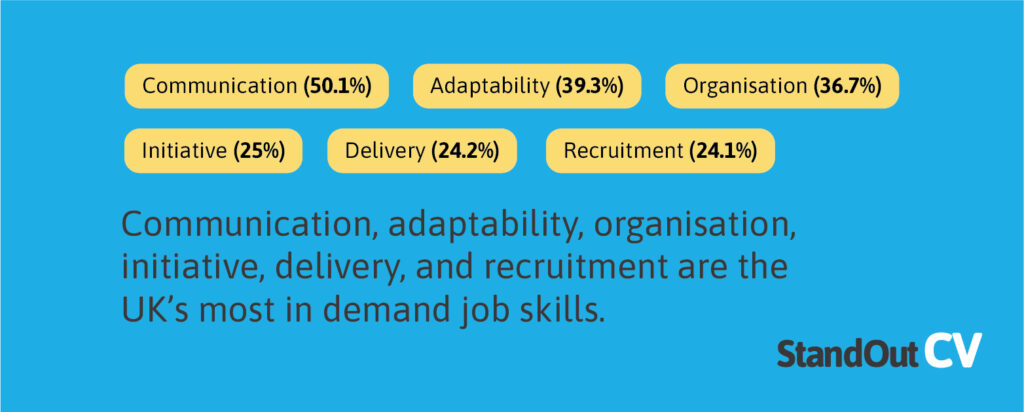
Other skills featured within the top 20 most in-demand skills, including customer service (22.5%), sales experience (17.7%), holding a driving licence (16.4%), and having a DBS check (14.2%), demonstrating the value employers place on both transferable skills and role-specific requirements.
Despite advances in technology and the growing influence of AI, the most in-demand skills remain centred around human capabilities, with communication, adaptability, and organisation ranking above many technical skills, indicating employers are prioritising candidates who can collaborate effectively, respond to change, and manage their responsibilities independently.
The most in demand job skills
| Rank | Skill | Percentage mentioned in job adverts |
|---|---|---|
| 1 | Communication | 50.1% |
| 2 | Adaptability | 39.3% |
| 3 | Organisation | 36.7% |
| 4 | Initiative | 25% |
| 5 | Delivery | 24.2% |
| 6 | Recruitment | 24.1% |
| 7 | Customer service | 22.5% |
| 8 | Regulatory compliance | 21% |
| 9 | Attention to detail | 20.1% |
| 10 | Collaboration | 19.9% |
| 11 | Sales | 17.7% |
| 12 | Leadership | 17.1% |
| 13 | Reporting | 16.8% |
| 14 | Driving licence | 16.4% |
| 15 | Health and safety | 15.8% |
| 16 | Planning | 15% |
| 17 | Teamwork | 14.2% |
| 17 | Administration | 14.2% |
| 17 | DBS check | 14.2% |
| 20 | Creativity | 12.5% |
The least in demand job skills
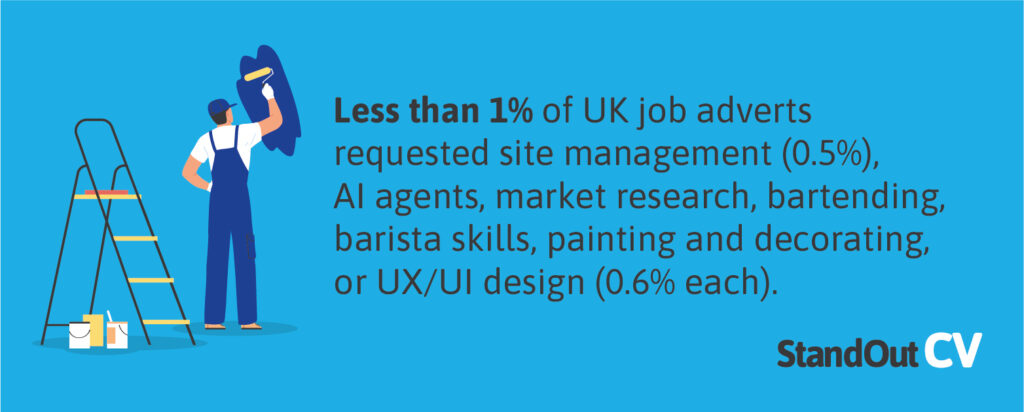
In comparison, site management was the least in-demand skill identified, appearing in just 0.5% of the job adverts analysed. Several other skills ranked only marginally higher, including AI agents, market research, bartending, barista skills, painting and decorating, and UX/UI design, with each appearing in just 0.6% of job postings.
| Rank | Skill | Percentage mentioned in job adverts |
|---|---|---|
| 1 | Site management | 0.5% |
| 2 | AI agents | 0.6% |
| 2 | Machine learning | 0.6% |
| 2 | Market research | 0.6% |
| 2 | DevOps | 0.6% |
| 2 | SAP | 0.6% |
| 2 | Active listening | 0.6% |
| 2 | Bartending | 0.6% |
| 2 | Barista skills | 0.6% |
| 2 | Painting and decorating | 0.6% |
| 2 | UX/UI design | 0.6% |
| 2 | Xero | 0.6% |
| 2 | CAD | 0.6% |
| 2 | Multitasking | 0.6% |
| 2 | Route planning | 0.6% |
| 2 | Delegation | 0.6% |
| 17 | HACCP | 0.7% |
| 17 | Infection control | 0.7% |
| 17 | Microsoft Word | 0.7% |
Which skills have the highest average salary?
For job seekers looking to strengthen their employability, understanding which skills offer the greatest earning potential can be just as important as knowing which ones are in demand. To explore this, the research analysed the average salaries associated with each of the 18 broader skill categories.
The findings reveal which areas offer the highest earning potential, helping job seekers identify where investing time and development could have the greatest impact on their career prospects.
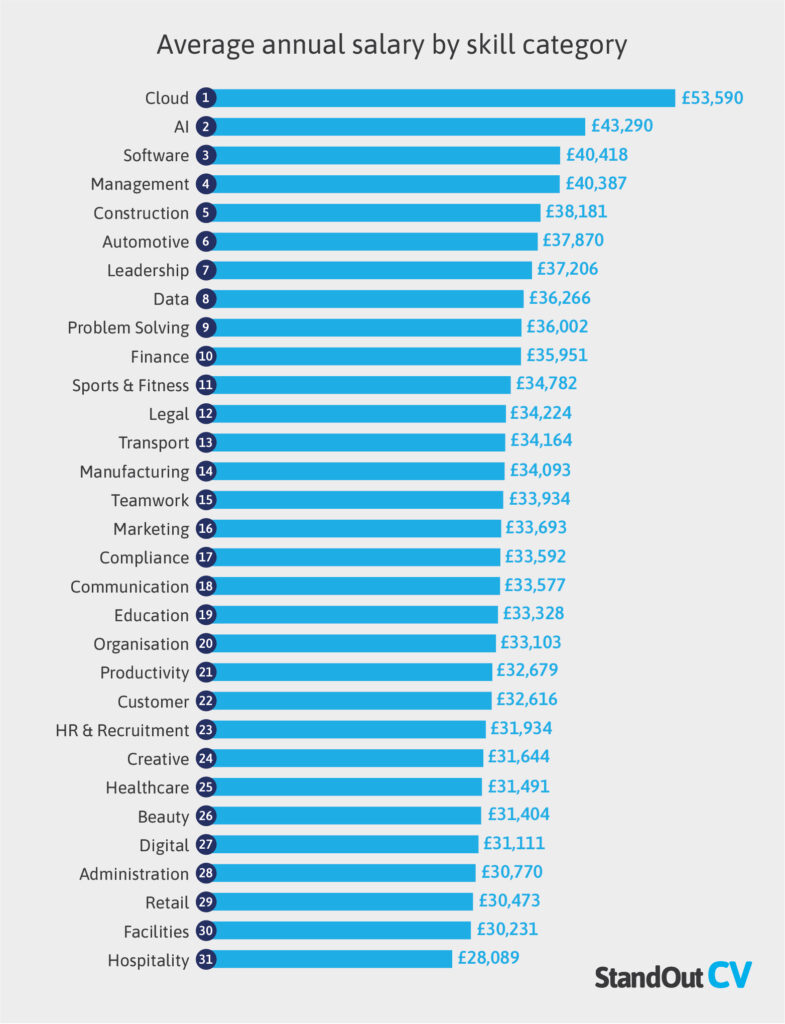
Average annual salary by skill category
| Rank | Skill | Average annual salary by skill category |
|---|---|---|
| 1 | Cloud | £53,590 |
| 2 | AI | £43,290 |
| 3 | Software | £40,418 |
| 4 | Management | £40,387 |
| 5 | Construction | £38,181 |
| 6 | Automotive | £37,870 |
| 7 | Leadership | £37,206 |
| 8 | Data | £36,266 |
| 9 | Problem Solving | £36,002 |
| 10 | Finance | £35,951 |
| 11 | Sports & Fitness | £34,782 |
| 12 | Legal | £34,224 |
| 13 | Transport | £34,164 |
| 14 | Manufacturing | £34,093 |
| 15 | Teamwork | £33,934 |
| 16 | Marketing | £33,693 |
| 17 | Compliance | £33,592 |
| 18 | Communication | £33,577 |
| 19 | Education | £33,328 |
| 20 | Organisation | £33,103 |
| 21 | Productivity | £32,679 |
| 22 | Customer | £32,616 |
| 23 | HR & Recruitment | £31,934 |
| 24 | Creative | £31,644 |
| 25 | Healthcare | £31,491 |
| 26 | Beauty | £31,404 |
| 27 | Digital | £31,111 |
| 28 | Administration | £30,770 |
| 29 | Retail | £30,473 |
| 30 | Facilities | £30,231 |
| 31 | Hospitality | £28,089 |
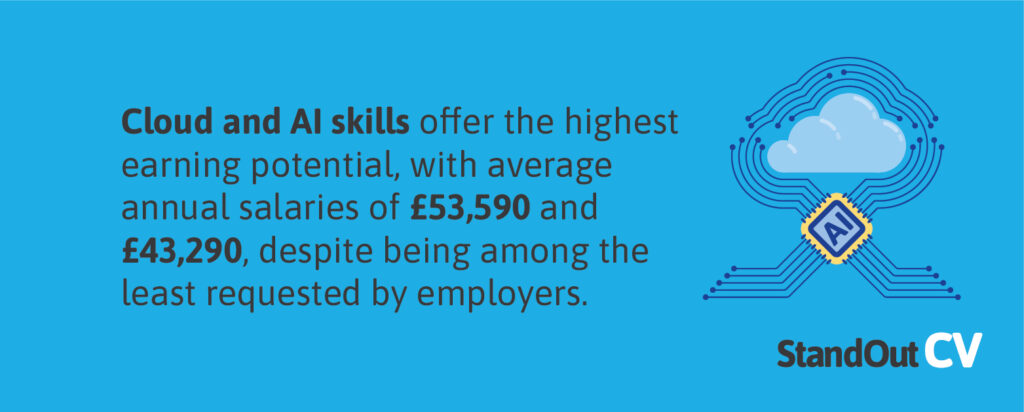
Despite being among the lower-demand skill areas identified in the research, cloud and AI skills command the highest average salaries, with roles requiring these skills offering average annual earnings of £53,590 and £43,290 respectively.
These were followed by software (£40,418), management (£40,387), and construction (£38,181), highlighting the strong earning potential associated with technical and specialist skill sets.
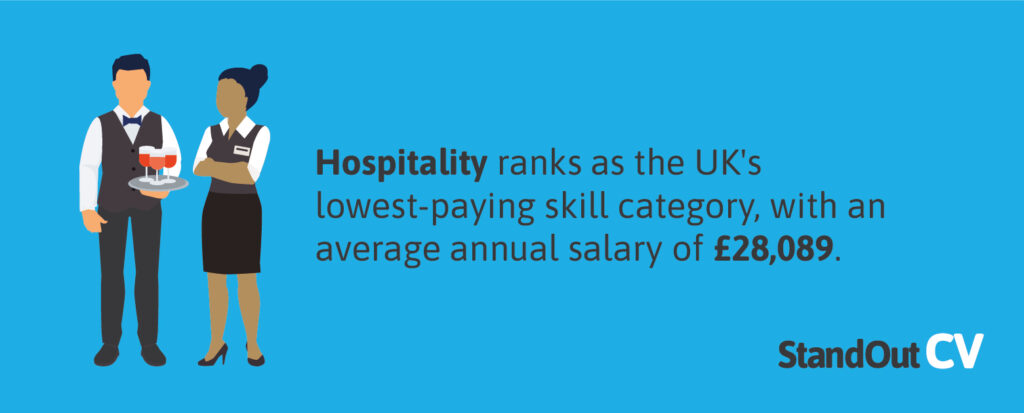
At the other end of the scale, hospitality recorded the lowest average annual salary at £28,089. This aligns with the research findings that hospitality-related skills, including bartending and barista skills, were among the least frequently requested by employers. The average salary for this category is £3,513 below the median average salary for UK workers.
However, demand and earning potential do not always go hand in hand. While HR and recruitment ranked as the ninth-lowest skill category by average salary, previous research by StandOut CV found that recruitment consultants can be among the highest paying jobs without a degree. Similarly, finance ranked as the tenth-highest average salary category, with previous research showing that roles such as financial controller can earn up to £67,114 annually, making finance one of the UK’s highest paying jobs.
The most in demand job skills by UK city
As part of the research, we also explored the most in-demand job skills across the UK’s 12 largest cities. By analysing local job adverts, we identified the skills employers are prioritising in each location, helping job seekers understand which capabilities could be most valuable for improving their career prospects in their area.
| Skill | City with the highest demand | City with the lowest demand |
|---|---|---|
| Communication | Belfast | Edinburgh |
| Organisation | Newcastle | Edinburgh |
| Adaptability | Glasgow | Nottingham |
| Regulatory compliance | London | Glasgow |
| Initiative | Leeds | Bristol |
| Collaboration | London | Sheffield |
| Reporting | Belfast | Sheffield |
| Sales | Leeds | Birmingham |
| Creativity | London | Sheffield |
| Leadership | Liverpool | Belfast |
| Attention to detail | Nottingham | Sheffield |
| Delivery | Sheffield | Glasgow |
| Self-management | Nottingham | Manchester |
| Recruitment | Leeds | Nottingham |
| Planning | London | Newcastle |
| Administration | Belfast | Liverpool |
| Customer service | Glasgow | Birmingham |
| Problem solving | Edinburgh | Sheffield |
| Diary management | Manchester | Edinburgh |
| Onboarding | Newcastle | Glasgow |
| Mentoring | Manchester | Sheffield |
| Microsoft Excel | Belfast | Sheffield |
| Prioritisation | Newcastle | Sheffield |
| Coaching | Liverpool | Glasgow |
| DBS check | Liverpool | Edinburgh |
| Learning and development | Manchester | Nottingham |
| Teamwork | Edinburgh | Manchester, Birmingham |
| Safeguarding | Sheffield | Belfast |
| Driving licence | Glasgow | London |
| Health and safety | Belfast | Bristol |
Although London is widely recognised as the UK’s business and financial capital, [4] the research found that it did not dominate the rankings for in-demand skills. The capital ranked highest for just three skills, while Belfast emerged as the strongest-performing city overall, recording the highest demand for five different skills: communication, reporting, administration, Microsoft Excel, and health and safety.
Elsewhere, Newcastle stood out for their demand of organisational skills, with more than half (50.7%) of job adverts requesting organisation, the highest percentage of any city analysed. Scotland also shows a clear trend, with Glasgow (49.1%) and Edinburgh (48.3%) recording the highest demand for adaptability, suggesting employers in these cities place a particularly strong emphasis on flexible, resilient employees.
At the other end of the scale, Bristol and Birmingham did not rank highest for any of the skills analysed. Bristol also recorded the lowest demand for two skills, initiative and health and safety.
Sheffield experienced the largest skills demand gap, recording the lowest percentage of job adverts for eight different skills: collaboration, reporting, creativity, attention to detail, problem solving, mentoring, Microsoft Excel, and prioritisation.
In contrast, Leeds did not record the lowest demand for any of the skills analysed, suggesting a more consistent demand for workplace skills across the city’s job market.
Most in demand skills for remote workers
Remote working statistics show that flexible working continues to play a major role in the UK job market. In 2025, 40% of Brits worked from home at least some of the time, while more than half of UK employers offered remote working opportunities.
With remote roles becoming an increasingly important part of the employment world, the research identified the top skills that job seekers can develop to improve their chances of securing a remote position.
| Rank | Top skills for remote jobs | Percentage of job adverts |
|---|---|---|
| 1 | Communication | 56.8% |
| 2 | Organisation | 46.3% |
| 3 | Adaptability | 43.6% |
| 4 | Regulatory compliance | 33.1% |
| 5 | Initiative | 32.7% |
| 6 | Collaboration | 30.7% |
| 7 | Reporting | 26.8% |
| 8 | Sales | 25.3% |
| 9 | Creativity | 24.1% |
| 10 | Leadership | 23% |
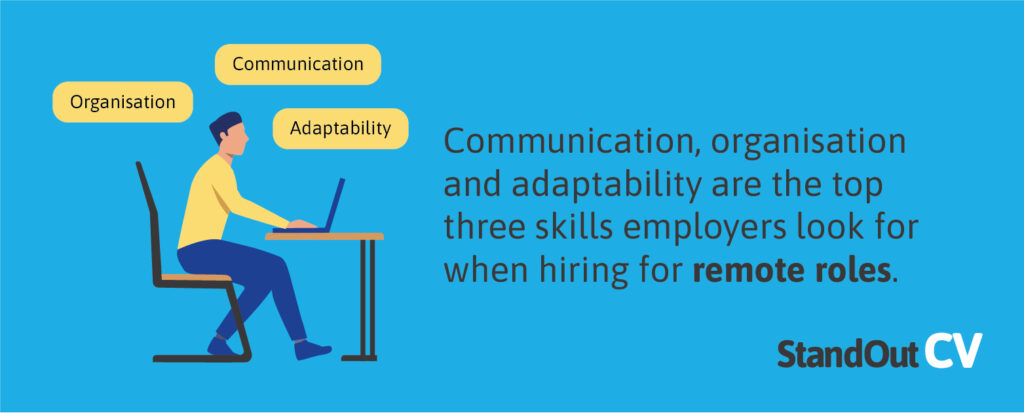
The research found that remote job seekers could improve their chances of securing a role by strengthening their communication skills, with 56.8% of remote job adverts analysed requesting this skill.
Other highly sought-after skills for remote roles included organisation (46.3%), adaptability (43.6%), and regulatory compliance (33.1%), highlighting the importance of effective communication, self-management, and the ability to work within structured processes when working remotely.
At the other end of the scale, the least requested skills for remote roles were health and safety (1.9%), having a driving licence (3.5%), safeguarding (3.9%), and teamwork (6.2%).
However, while teamwork appeared less frequently in remote job adverts, collaboration ranked among the top 10 most in-demand skills (30.7%). This suggests that although traditional teamwork may be less commonly referenced, employers still place strong value on the ability to collaborate effectively within remote working environments.
Most in demand skills by seniority level
Salary is not the only factor job seekers consider when searching for their next opportunity. The level of seniority associated with a role can also influence the skills employers value most and the opportunities available.
With this in mind, the research explored the most in-demand job skills across different career stages, from apprentice and entry-level positions through to senior leadership roles such as director.
| Seniority level | Most in demand skill | Percentage of job adverts |
|---|---|---|
| Director | Leadership | 70.3% |
| Principle | Collaboration | 62.9% |
| Senior | Communication | 54.7% |
| Lead | Communication | 55.9% |
| Junior | Organisation | 50.8% |
| Trainee | Communication | 54.4% |
| Apprentice | Communication | 52.4% |
| Graduate | Adaptability | 56.7% |
For those targeting senior leadership positions, the research found that leadership was the most in-demand skill for director-level roles, appearing in 70.3% of job adverts analysed. This was followed by collaboration (48.5%), highlighting the importance of guiding teams and working effectively with others.
At the principal level, collaboration took the top spot, appearing in 62.9% of roles, closely followed by leadership (60%). For senior and lead roles, communication was the most sought-after skill, appearing in 54.7% and 55.9% of job adverts respectively.
Among more junior positions, organisation was the most in-demand skill for junior roles (50.8%), while communication was key for trainee (54.4%) and apprentice roles (52.4%). For graduate roles, adaptability ranked highest, appearing in 56.7% of job adverts analysed.
Methodology
The research analysed 20,783 UK job adverts collected from Indeed. After removing duplicate listings, a total of 18,316 unique job adverts across 23 different industries were included in the final analysis.
Each job advert was analysed to identify key information, including salary, location, industry, seniority level and the skills requested by employers.
A list of 285 workplace skills was created and grouped into 18 skill categories. Job adverts were then searched to identify which skills employers were looking for, with each skill counted only once per advert, regardless of how many times it appeared.
The findings were then used to compare demand for skills across industries, locations, salaries, remote roles and seniority levels.
Data assumptions: Salaries advertised as hourly, daily or weekly rates were converted into annual salaries based on a standard full-time working week.
Sources
[1] Office of National Statistics, ‘Vacancies and jobs in the UK: July 2026’, 2026
[2] Demand Sage, ‘ChatGPT Statistics (July 2026) – Latest Active Users Data’, 2026
[3] Kings College London, ‘New study reveals early impact of AI on job market in UK’, 2025
[4] UK Government, ‘UK nations and regions’,